

FLYING Magazine
A pair of electric aircraft prototypes landed on the runway at Tampa International Airport (KTPA) on Friday as Florida looks to evaluate a planned aerial highway network.
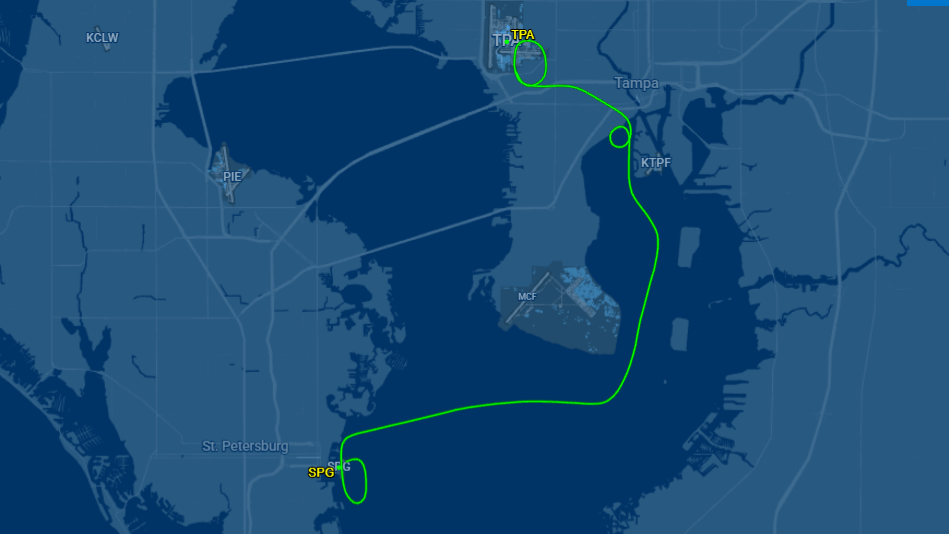
According to FlightAware, Joby Aviation’s electric vertical takeoff and landing (eVTOL) prototype registered N545JX took off from Albert Whitted Airport (KSPG) in St. Petersburg at 10:01 a.m. EDT and landed at Tampa International (KTPA) 20 minutes later. Per audio captured on the ATC app, the air taxi circled in the Tampa area before entering Class B airspace. It then made a low approach and entered the right downwind to land at Tampa International’s Runway 1R.
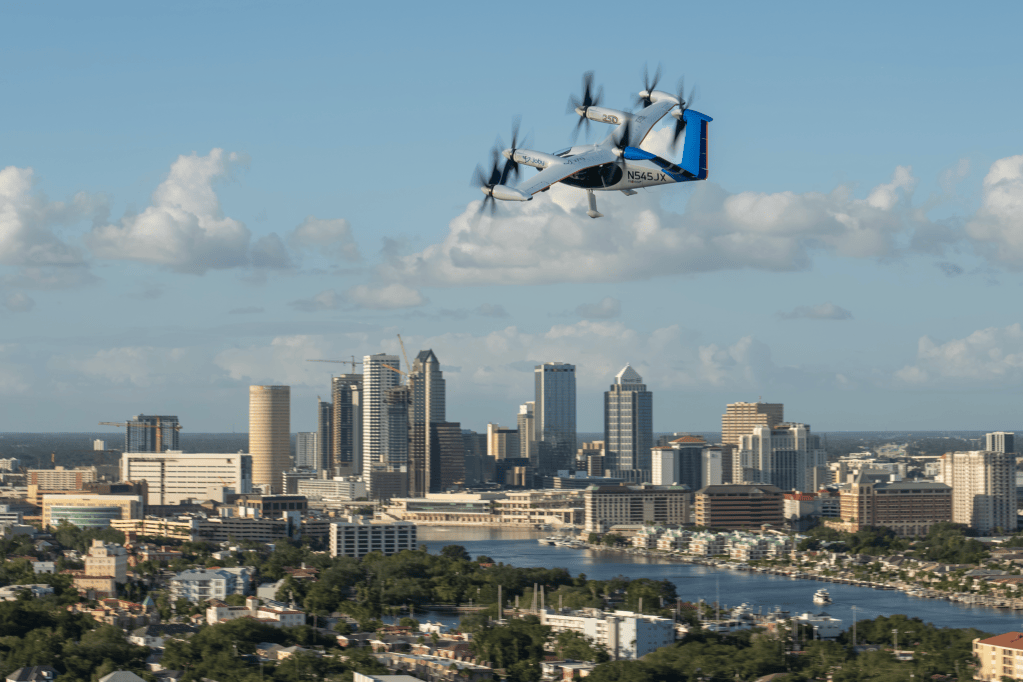
The model is a preproduction prototype of the manufacturer’s planned eVTOL air taxi, which is designed for a pilot to fly up to four passengers on quiet, zero-emission trips reaching speeds up to 200 mph. It has six tilting propellers that give it VTOL capability while also supporting wingborne cruise. It is unclear whether the model landed vertically or conventionally at Tampa, but it did take off vertically from Albert Whitted.
Beta Technologies’ CX300, a conventional takeoff and landing (CTOL) electric prototype, took off from Albert Whitted’s runway and joined Joby’s air taxi in a formation flight, also landing at Tampa. St. Petersburg-based digital news outlet I Love The Burg shared footage of the two aircraft flying together.
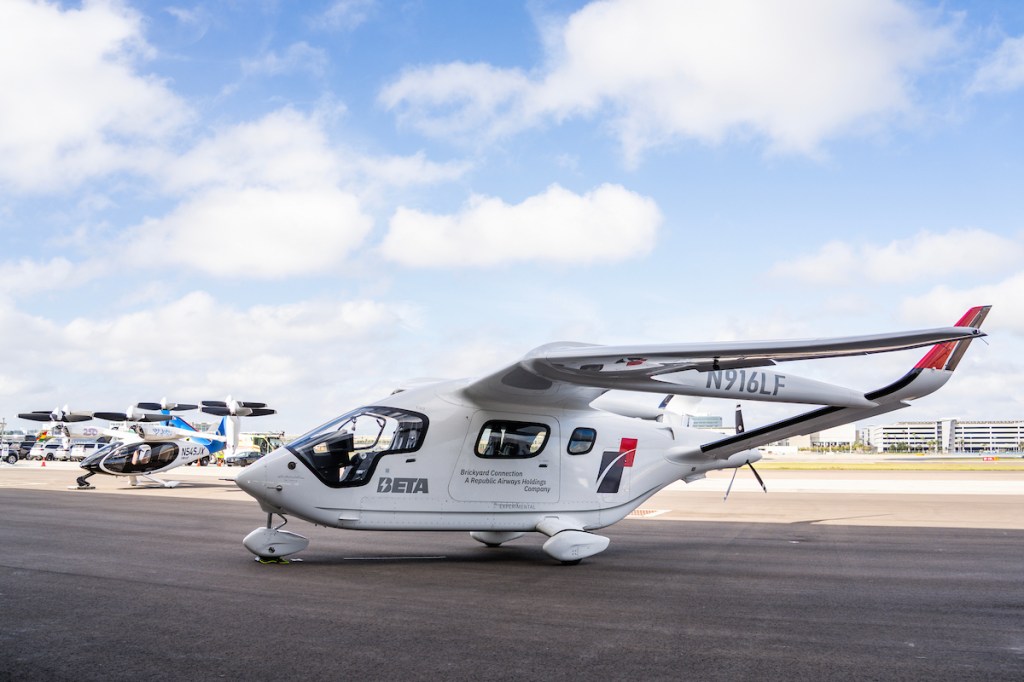
The CX300 is designed for a pilot and up to five passengers or up to 1,250 pounds of cargo, cruising at up to 153 knots. It has a demonstrated range of 336 nm. Whereas Joby is primarily focused on commercial passenger operations, Beta bills the CX300 as a multiuse aircraft for regional passenger, cargo,medical, and emergency response services. It is also developing an eVTOL aircraft, the Alia 250, and an MV250 defense variant.
Florida Governor Ron DeSantis and other officials attended the demonstration.
Tracing Jannus’ Pioneering Route
Joby said Friday’s flight was intended to trace the route flown by pioneering aviator Tony Jannus on January 1, 1914, which is recognized as the world’s first scheduled commercial airline flight.
According to the Tony Jannus Distinguished Aviation Society, a nonprofit that bestows an annual award named after Jannus, the pilot had little to no formal aeronautical training. On New Year’s Day in 1914, Jannus and the mayor of St. Petersburg embarked on a flight across Tampa Bay in a Benoist XIV flying boat and landed in Tampa about 23 minutes later.
The flight was the first of the St. Petersburg-Tampa Airboat Line, considered the first fixed-wing scheduled airline in the U.S. The one-way fare was $5, and every seat was a window seat.
Jannus died in 1916 during a Curtiss Model K boat crash over the Black Sea, and his body was never recovered. In 1964, the Tampa and St. Petersburg Chambers of Commerce established the Aviation Society in his name.
More Electric Aircraft Activities Planned
Joby and Beta said the activities inaugurated the Florida Department of Transportation (FDOT)-led eVTOL Integration Pilot Program (eIPP) project, which is designed to collect operational data on the novel, precertified aircraft. Data will be shared with the FAA to help the agency create rules and guidance for their safe integration.
FDOT’s project is the seventh of eight to get underway. It will trial cargo delivery, passenger transport, automation, and medical response.
“Each flight provides crucial data and lessons learned that will help establish safety standards for everyday operations,” FAA Administrator Bryan Bedford said in a news release Friday.
Joby characterized Friday’s sortie as the first in a weeklong Florida demonstration campaign. The company’s testing will focus on passenger operations.
According to Joby, the prototype air taxi will conduct out-and-back flights at Orlando International Airport (KMCO) in early November. It said FDOT recently built a vertiport near the airport’s Terminal C, which will be used for the demonstrations. DeSantis in April signed a bill that authorized FDOT to fund the construction of such facilities, which will be similar to heliports but equipped with electric chargers and other infrastructure to accommodate eVTOL models.
Joby in 2024 partnered with the FAA, Greater Orlando Aviation Authority, and Orlando air traffic controllers to conduct simulations of the integration of eVTOL vehicles with other traffic a the airport. But the upcoming activities will represent a real-world test.
Joby’s eVTOL will also conduct demonstration flights at the Shuttle Landing Facility at NASA’s Kennedy Space Center as part of the 2026 UP.Summit, which runs November 4-6.
Beta, in partnership with Republic Airways, Brickyard Connection, and Metro Aviation, is also part of FDOT’s eIPP. It has also flown out of Orlando International and St. Pete-Clearwater International Airport (KPIE). The company said the CX300 has already logged nearly 700 nm across 14 flights in Florida.
Through an agreement with FDOT, Beta has also installed electric chargers at nine Florida sites—including general aviation airports—with more to come. It plans to trial cargo and medical logistics operations across the state.
In November, FDOT and Electra will conduct flight tests in several locations throughout central Florida, according to the U.S. Transportation Department. They will demonstrate “access points” that are designed to allow Electra’s flagship EL9 Ultra Short to operate from unused parking spaces, piers, barges, malls, and even destinations such as casinos and ski resorts.
FDOT is also partnered with eVTOL air taxi developer Archer Aviation, which has yet to announce flights under the project.
Florida’s Aerial Highway Network
FDOT for about five years has been developing plans for an interstate aerial highway network that will make use of electric and eVTOL aircraft for passenger transport, cargo delivery, and other applications. In 2025, it released a proposal and phased plan to introduce intercity AAM operations statewide, from Pensacola to Key West.
Phase one calls for aerial corridors over Florida’s Interstate 4 and along the coast from Miami to Port St. Lucie. Three more routes would connect Tampa and Naples, Miami and Key West, and Pensacola and Tallahassee. A second phase comprises routes connecting Daytona Beach and Jacksonville, Orlando and Lake City, Tampa and Tallahassee, Jacksonville and Tallahassee, and traveling east and west out of Sebring.
Joby said its Friday flight and upcoming activities are taking place at sites that will become some of the first hubs in the aerial network.
The highway-in-the-sky system would require vertiport installations at the state’s major airports, such as the one recently constructed at Orlando International. The bill DeSantis approved in April will allow private companies to assist with vertiport design, building, construction, financing, management, and operation.