

FLYING Magazine
In beginning research for this article, it was assumed that artificial intelligence technology was nowhere near ready for general aviation cockpits. Sure, free access to ChatGPT is available to anyone with an internet connection, but how close are companies to actually bringing solutions to the cockpit?
After a cursory look, there are more than a dozen companies identified as working on products that will use programming performed by AI or will collect information that the technology will process for use in a final software product destined for a cockpit. While some of the companies are developing solutions for transport category and military aircraft, there’s much development happening in GA, some of which is already in-market.
If you’re not already a subscriber, what are you waiting for? Subscribe today to get the issue as soon as it is released in either Print or Digital formats.
FAA Administrator Bryan Bedford (the former chief executive of Republic Airways) has been optimistic about also embracing machine learning and AI technology to help the national air traffic control (ATC) system provide safe separation of aircraft, which at the end of the day, is the agency’s primary job. As Bedford told FLYING in an exclusive interview in the June/Issue 971, this isn’t a far-distant future state, as implementation is expected to be tested and deployed by the end of 2028.
Some small GA startups are already making big waves, like Airhart, whose new approach to avionics and flight control systems aims to make light airplanes simpler to fly and faster to learn. A simplified joystick controller, automated rudder controls, and a full fly-by-wire system are just part of what is in development. If certified, Airhart may be a company that will reshape how the GA cockpit looks and functions.
- READ MORE: Are U.S. Airports Ready for Electric Atmosphere?
- READ MORE: Electric and Autonomous Aircraft Trials Set to Begin in Louisiana
Let’s explore three additional companies that have launched or are in the FAA certification process as of mid-May. Two founders interviewed are active GA pilots and airplane owners, lending perspective on challenges for this segment of the aviation industry.
PlaneDNA
PlaneDNA seeks to change how pilots access and learn about their aircraft through AI-assisted insights.
Founder Josh Mac is a private pilot and airplane owner who designed PlaneDNA to help owners and prospective buyers make sense of their aircraft logbooks. Mac’s interest in this problem began when he attempted to piece together a coherent picture of his 1958 Beechcraft Bonanza’s maintenance history and learned firsthand how overwhelming the process can be.
“A typical GA aircraft has decades of handwritten entries across airframe, engine, and prop logs, much of it in different handwriting, written on faded pages, and some have recurring ADs that need to be reconciled against the FAA’s database,” Mac said. “It took me weeks to feel confident that I understood the Bonanza’s history as I had to review logbooks going back to the Eisenhower administration.”
The problem for airplane buyers is that a review of this material has to be done quickly to keep a sale moving forward. Most sellers are helpful but can’t be expected to wait a few weeks for a record review to be completed.
“Typically a buyer doesn’t have weeks to feel confident about the logbooks, which means making a large purchase without understanding the full history of the airplane,” Mac said. “I kept thinking this should be a solved problem, so I built the tool I wished I’d had.”
Once the full maintenance records are uploaded into PlaneDNA’s dashboard, the service uses machine learning and optical character recognition (OCR) to ingest scanned or photographed logbook pages, including handwritten entries—a notoriously difficult task for early AI tech—and then converts the information into structured, searchable data that can be queried in seconds. Here, PlaneDNA is applying AI to digitize, collate, and interpret an airplane’s full maintenance records, which has always been a historically manual, long, and tedious process.
Using PlaneDNA, the pilot can query the maintenance history of their own airplane, submitting questions in plain English. It will automatically extract key details, like flight hours, inspections, and repairs, and can identify maintenance patterns or recurring issues. This feature, called Ask Your Copilot, allows an airplane owner to ask direct questions like, “when was the last magneto inspection?” or “has this aircraft ever had a prop strike?” They will receive a near-instant answer with the relevant logbook entry as a reference.
In addition, PlaneDNA integrates with the FAA’s airworthiness directive (AD) databases, matching the owner’s airplane and powerplant with the maintenance records and logbooks they uploaded to determine what ADs have been completed and any outstanding. Also, the service will alert the owner if new ADs are issued.
By digitizing handwritten maintenance records, PlaneDNA helps reduce the risk of overlooked ADs caused by manual tracking, incomplete logs, or ownership and equipment changes.
In the GA fleet, where 40-to-60-year-old airplanes are common, an owner may need to sort through an incomplete maintenance history. By transforming a mix of handwritten and digital records into a searchable decision-support system, an aircraft’s history becomes a dynamic digital record that’s instantly searchable.
“The logbook stops being a passive record and becomes a tool owners can use to properly maintain their aircraft,” Mac said.
Interested pilots can start a free trial or purchase a monthly or annual subscription from PlaneDNA’s website (planedna.com).
Merlin Pilot
Now, as we move from the logbook to the cockpit, Boston-based Merlin Labs is working to bring the future of aviation into the present.
Commercial-rated GA pilot Matthew George started the company eight years ago in Somerville, Massachusetts, and now Merlin is trading on the Nasdaq Stock Market as MRLN, focused on bringing autonomous technology into certified aircraft cockpits.
George’s vision for Merlin is equal parts measured and ambitious, as he and his team intend to certify an airplane-agnostic, AI-powered software platform called Merlin Pilot into GA cockpits. Merlin Pilot will act as a safety pilot, monitoring all aircraft systems and flight parameters, ready to offer assistance verbally if it detects a situation where the pilot might be task saturated and missing critical aircraft inputs that could impact the overall safety of the flight. Eventually, in a fully autonomous capacity, the software could conduct the entire flight if a pilot felt conditions were above their personal minimums but still within the confines of the safe operating envelope of the airplane.
George, who regularly flies a Cirrus SR22, shared his enjoyment of shooting an approach down to minimums in a recent recurrency flight. However, he acknowledged that sometimes human pilots are simply not at their best, and that’s where Merlin Pilot could step in and offer instant assistance.
For example, picture an instrument arrival into a busy terminal area in IMC. In the background, Merlin Pilot hears the human pilot miss a radio call from the approach controller and offers to take over radio communications with ATC using its learned natural language processing technology. Then, as the airplane turns onto a 3-mile final for landing, it detects the airplane’s gear has not been lowered and alerts the pilot, who has fallen behind the airplane in this critical phase of the flight. On short final, it reminds the pilot to increase the airplane’s airspeed as it has rapidly deteriorated without the pilot noticing, helping to avert a stall/spin accident at low altitude where recovery isn’t possible.
Merlin’s goal is to go beyond the helpful software-based, virtual safety pilot and have Merlin Pilot conduct a fully autonomous flight when called upon. In fact, test flights are already happening at Quonset State Airport (KOQU) in Rhode Island and Kerikeri, New Zealand, with Merlin Pilot flying its Cessna 208 Caravans with a safety pilot aboard monitoring the flight.
With the press of a button, the Merlin Caravan can complete a full test flight from takeoff to touchdown. According to George, AI in the cockpit, in the form of Merlin Pilot, will be a “safety feature that we’re in the process of certifying now to bring forward the future of general aviation.”
George said bringing Merlin Pilot to GA cockpits represents only the first step in the company’s mission. With a market capitalization of nearly $900 million and a $100 million prime contract with the U.S. military, Merlin is working toward certification of its AI-powered “autonomy stack” to deliver reduced aircrew operations for the U.S. Special Operations Command’s fleet of C-130J Super Hercules.
In a recent announcement, George shared plans to scale beyond military transport airplanes and into civil cargo aircraft. Called “Condor,” this new product line will use the same core technology from Merlin Pilot but be adapted to transport category airplanes already being flown by cargo operations with the goal of reducing multicrew operations.
With plans to expand the flight test and research operations to Hanscom Field (KBED) outside of Boston, George said he has the funding, a talented team, and some strong early results to continue bringing his vision into reality at Merlin Labs (merlinlabs.com).
“We’re now past the point of experimentation and are actively working on what the next generation of aircraft autonomy is going to be,” he said. “It is exciting. We’re helping to build what the next 100 years in aviation is going to look like.”
George addressed the natural discomfort that some GA pilots might feel when considering an AI-powered Merlin Pilot backing them up in the cockpit.
“We as pilots owe it to ourselves, our families, and the general public to continue to make general aviation safer,” he said, pointing to decades of civil aviation accident data that “shows how having a second set of eyes [human or AI] dramatically improves overall safety.”
Daedalean PilotEye
Daedalean is working on building a second set of virtual eyes in general aviation airplanes using cameras and AI technology to recognize aircraft-shaped objects that could pose a collision hazard during flight. Purchased by Destinus (destinus.com) in 2025, Switzerland-based Daedalean’s PilotEye is undergoing cerification testing with the FAA.
According to the company, PilotEye is being trained, or “machine-learned,” (which refers to learning done in a controlled lab setting rather than live) to see into cloud layers, detect power lines, towers, and more dynamic moving targets like birds, drones, and airplanes. It is designed to augment the pilot’s vision by detecting such potential collision targets, which are identified and displayed in the cockpit, and warning of these safety hazards. PilotEye will be installed on the airplane and operate separately from the ADS-B/TIS-B traffic identification system, searching the sky in front and around the airplane for targets.
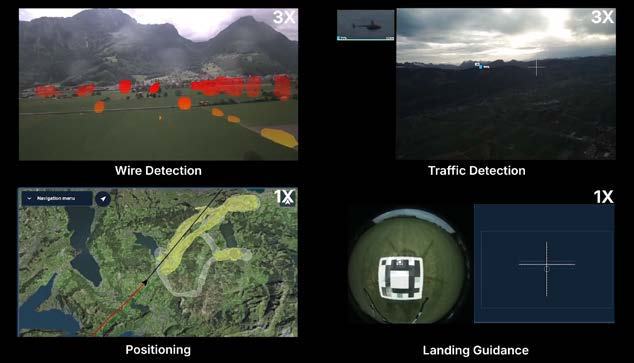
PilotEye’s computer vision will interpret the external environment around the airplane and is a critical ingredient for any future fully autonomous system, which must first be able to reliably see and make sense of its surroundings. Officials said this technology represents a different, more incremental approach to AI in aviation. Using camera inputs and neural networks to detect airborne hazards, it will go beyond ADS-B to spot other flying targets, focusing on airborne objects that are not typically visible to traditional systems. As an “extra set of eyes,” it continuously scans the environment and alerts pilots to potential conflicts, effectively augmenting the human already working to “see and avoid” during flight.
What makes the software especially significant, according to Daedalean, is that the tech is being developed with general aviation as a primary use case. Beyond simple detection, the system is evolving toward full detect-and-avoid capability, which is a key requirement for autonomous and beyond visual line of sight (BVLOS) operations. The company maintains this means improved midair collision detection at altitudes and in airspace that are common for GA flights and better awareness in low-visibility or congested urban/suburban environments, where collision hazards can be more difficult to spot at low altitudes when objects are operating against a crowded visual backdrop of buildings and structures.
Trained by machine-learned AI inputs, once certified, Daedalean said PilotEye will be available to aircraft OEMs who want a drop-in system that will aid a human pilot’s “see-and-avoid” efforts.
Safer Future
The work being done at PlaneDNA, Merlin Labs, and Daedalean, AI technology is being used to train and develop software-based solutions that each play a part in improving an aspect of GA safety. All three companies envision AI technology stacks will integrate into new aircraft at a conservative pace, as Merlin and Daedalean still must sell their software to aircraft OEMs once FAA certification is complete.
Just like the first Garmin G1000s, adoption across the fleet likely will take time, and pilots will probably have a lot of choice in how much automation they use in their cockpit.
AI is coming to assist smoother buyer/seller transactions too. In May, Aerista, a leading pre-owned Cirrus brokerage firm, announced it had formed a strategic partnership with Aviox to improve valuation and deal timing to the aircraft sale transaction process.
As the GA fleet ages, it will be useful for pilots to have tools for staying on top of maintenance, mechanical conditions, and complying with ADs.
Perhaps future private pilot training courses will include cockpit resource management with software-based AI systems like those mentioned. Hopefully this technology will help reduce the total number of GA accidents and fatalities, which is a worthy goal that all pilots will benefit from if these companies deliver on their collective vision.
This feature first appeared in the July Issue 972 of the FLYING print edition.