

FLYING Magazine
The experimental, supersonic X-59, developed for NASA by Lockheed Martin, may be just months away from soaring over communities across the U.S.
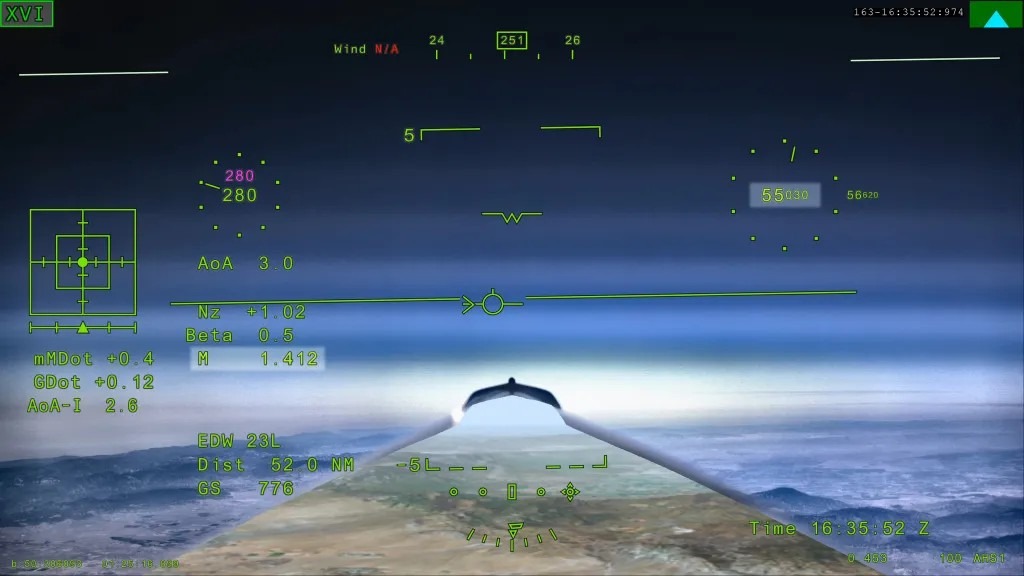
The X-59—sometimes dubbed the “Son of Concorde” for its potential to spur a renaissance in supersonic commercial flight—hit Mach 1 for the first time in June after a series of envelope expansion flights following its debut in October. On Friday, NASA said the aircraft achieved a speed of Mach 1.4 (about 924 mph) and altitude of 55,000 feet, figures the space agency sought to hit when it embarked on its Quiet SuperSonic Technology (Quesst) project.
That performance is intended to emulate how future supersonic commercial airliners may operate. NASA will fly the X-59—designed to produce a quiet sonic “thump” rather than a boom—at the same speed and altitude during community surveys, gauging people’s perception of its noise.
The experimental aircraft will never fly paying customers. But NASA will share the data it collects with U.S. and international regulators, which could help them establish noise standards that permit supersonic flight over land. The FAA since 1973 has restricted commercial supersonic overland flights, which limited Concorde mainly to routes out of New York, Washington, D.C., London, and Paris.
The White House last year passed an executive order directing the regulator to reverse the longstanding ban. In March, the House passed a bill that, within one year of adoption, would require the FAA to permit supersonic flights over land so long as no sonic boom is audible below. The legislation is awaiting a Senate vote.
NASA will also use the X-59 program to create design tools for aircraft manufacturers, allowing them to validate the noise profiles of their own designs. Boom Supersonic in early 2025 broke the sound barrier with its XB-1 demonstrator and said the sonic boom was not picked up by microphones below the flight path. The company believes its planned Overture airliner will achieve the same low noise output.
Boom is one of two companies with FAA special flight authorization to exceed Mach 1 over land for testing purposes. The other, Hermeus, completed the first supersonic flight of its Quarterhorse Mk 2.1—an uncrewed prototype—in May.
X-59 Accelerates
The X-59 entered a quiet period for maintenance after making its first flight from Lockheed Martin’s Skunk Works facility to NASA’s Armstrong Flight Research Center in California in October.
Recently, it has been busier, completing 16 flights in the 90 days leading up to its debut supersonic sortie on June 5, per NASA Administrator Jared Isaacman. Experimenters have been flying the aircraft at progressively higher speeds and conducting a battery of maneuvers to test its performance under a range of conditions.
Now, they are testing under the conditions envisioned for the X-59 community noise survey, the cornerstone of the Quesst program.
The aircraft’s speed of just over Mach 1.4 and altitude of 55,030 feet were validated Friday by its eXternal Vision System (XVS). The XVS stands in for cockpit windows, which were removed because the X-59’s Pinocchio-like nose—extending about one-third of its nearly 100-foot length—would block the view.
The long, slender nose is designed to break up shock waves in front of the aircraft. A top-mounted, F-18 Super Hornet engine gives the experimental plane a smooth underside, intended to prevent sound waves from merging in its wake.
NASA in a news release said “months of performance testing” remain for the X-59. Researchers will continue to expand the envelope and test under various speeds, altitudes, and conditions. Supersonic F-15 chase aircraft will accompany the X-59 for these flights, obscuring any noise it may produce. But it will use a special probe to measure the aircraft’s shock wave signature.
Once that is complete, the X-59 will head from Armstrong to nearby Edwards Air Force Base (KEDW) for a dedicated acoustic validation phase. This pivotal step will see experimenters prove—or disprove—the aircraft’s noise-cancelling ability.
Should the latter phase go to plan, NASA will gear up for the community noise survey. Per a notice it published in the Federal Register in May, the space agency proposes to conduct up to five 30-day studies concentrated in different regions, each covering 1,000 respondents. It hopes to solicit 350,000 annual responses and collect responses up to six times daily, implying the X-59 would fly at that cadence.
FLYING readers can track flights of the X-59 and other NASA aircraft using the space agency’s Airborne Science Program Tracker.
NASA and the National Atmospheric and Oceanic Administration (NOAA) additionally fly the modified Martin B-7 Canberra (as the WB-57), modified Lockheed U-2 (as the ER-2), P-3 Orion, and other research aircraft.