

FLYING Magazine
Precertified electric air taxis have begun a weeklong demonstration campaign in Texas that will see them fly directly into airports alongside regular air traffic, under a contract with the FAA.
Joby Aviation said Thursday that the activities involving its preproduction prototype eVTOL aircraft, which has not yet been type certified, will show off the air taxi’s “ability to integrate into busy airspace,” including the controlled airspace of Dallas/Fort Worth International Airport (KDFW).
The air taxi is not yet flying with passengers. But Joby aims to demonstrate real-world routes across North Texas, including connections to “major urban hubs,” as it pursues certification in the coming months.
The campaign kicked off Thursday with a flight at Perot Field Fort Worth Alliance Airport (KAFW), which Joby said featured a “joint flight demonstration” including its own aircraft and those from other unnamed manufacturers. The activities are expected to continue through Monday, with the schedule subject to change pending weather conditions and other factors.
Joby routinely flies its prototype aircraft in testing environments as well as real airports. Earlier this year, the air taxi flew over the San Francisco Bay and took off from John F. Kennedy International (KJFK), later landing across New York City’s heliport network.
But the new weeklong campaign, being conducted in partnership with the Texas Department of Transportation (TxDOT), is different.
Unlike Joby’s previous demonstrations, this week’s flights are part of the FAA’s eVTOL Integration Pilot Program (eIPP) and are being conducted under a signed other transaction agreement (OTA) with the agency. The eIPP, which will span three years and 26 states, is designed to help the FAA identify gaps in existing regulations for aircraft such as Joby’s, improve procedures, and ultimately support their safe integration into the National Airspace System (NAS).
“The FAA is leveraging data from test flights in Texas and across the country to ensure these new aircraft integrate safely into the airspace,” said FAA Administrator Bryan Bedford in a statement shared by Joby.
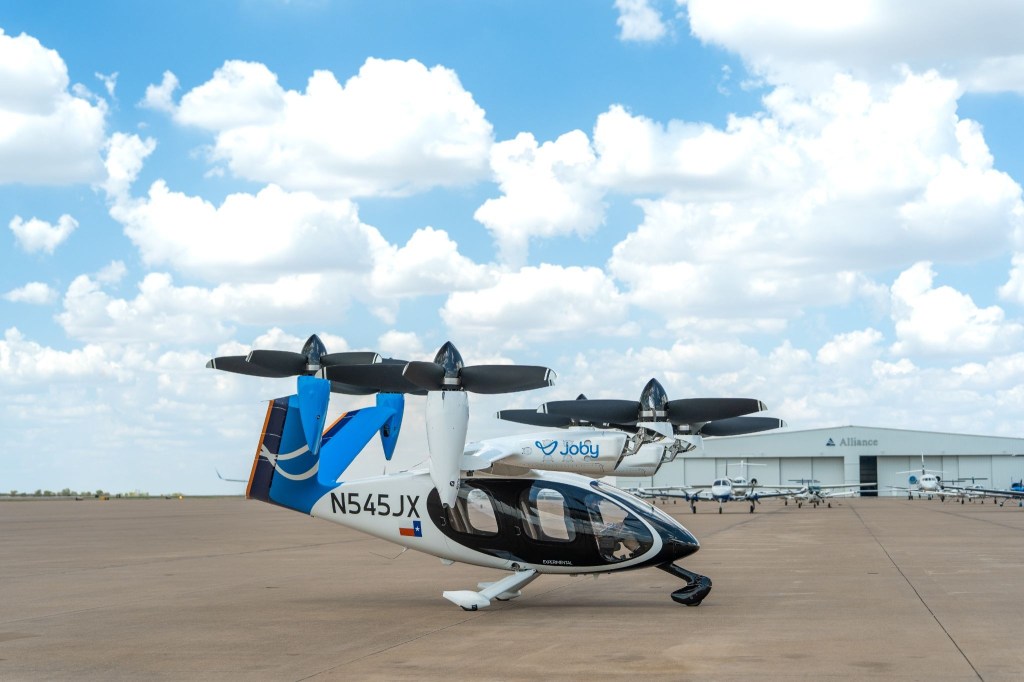
The OTA establishes planned activities and requirements for data reporting to the FAA. Both the agency and operators selected for the eIPP have raised the possibility of the program eventually permitting passenger-carrying flights with precertified models for revenue.
“Over time, and with extensive involvement and oversight from the FAA, we expect flights under the eIPP program to progress from those with only a pilot on board to those carrying non-paying passengers and eventually paying passengers,” said JoeBen Bevirt, founder and CEO of Joby, on the company’s second-quarter earnings call in August.
Unlike internal test flights, the eIPP activities are highly coordinated between private manufacturers, operators, and service providers and federal, state, and local governments. TxDOT is one of the eight lead partners for the program.
What’s Next?
On Saturday, Joby plans to fly the air taxi from Perot Field to Dallas/Fort Worth International. There, it will fly regional routes connecting to the airport and land at Corporate Aviation’s FBO site. The company said the vehicle will take off from KDFW against active commercial airline traffic, representing one of the earliest examples of mixed traffic operations involving an eVTOL at a real airport.
Joby and NASA in 2023 conducted a simulation at the space agency’s Ames Research Center in California that looked at the feasibility of operating up to 50 electric air taxi operations per hour at the airport’s terminal area.
The next activities in the campaign will be round-trip flights from Perot Field to Arlington, Texas, overflying the Fort Worth Stockyards and other major infrastructure. Then will come a flight along a “planned operational route” connecting Perot Field and Toyota Motor North America’s corporate headquarters in Plano. Toyota is an investor and strategic manufacturing partner for Joby.
Joby in August leased 45,000 square feet at Perot Field that it said will serve as its base for future activities in Texas. The manufacturer on Thursday also brought an autonomous aircraft, which it refers to as J208, to the airport. J208 is a Cessna 208B Grand Caravan equipped with autonomous flight technology that will continue on to South Carolina, North Carolina, Washington, D.C., Kentucky, Kansas, Oklahoma, and Utah this month, before returning to the West Coast.
However, there is plenty more to come in Texas.
In addition to Joby, TxDOT has partnered with electric aircraft manufacturers Beta Technologies and Archer Aviation, as well as the latter’s Wisk Aero autonomous air taxi subsidiary, for the eIPP. The partners intend to conduct regional flights connecting Dallas, Austin, San Antonio, and eventually Houston, with air taxi networks expanding from each city to extend the air taxis’ regional reach.
Archer and Beta plan to install electric chargers at airports, FBOs, and “other points of interest” to support TxDOT’s eIPP project. Both are planning all-electric air taxi flights in the state “in the coming months,” per a news release shared by Archer Thursday.
The TxDOT program is called Project Nexus. Per the agency’s website, novel aircraft could “revolutionize how we move people and goods, offering faster, more efficient, and potentially more sustainable transportation options.” Vertiports could allow eVTOL models to operate away from airports and closer to where people live and work.
“Project Nexus creates a multi-state ‘System of Systems’ to safely integrate Advanced Air Mobility (AAM) into the NAS,” TxDOT said. “By uniting Texas, Oklahoma, Louisiana, and the Choctaw Nation, the project offers the FAA a diverse operational sandbox. This environment spans dense urban centers, a coastal energy corridor, and rural sovereign lands.”
In March, TxDOT said the project’s first phase involved testing without passengers and with traditional aircraft like helicopters and fixed-wing aircraft. A second phase will comprise testing for medical and cargo logistics, such as transporting critical medical supplies or organs between rural and urban medical centers in Austin and San Antonio. The final phase, it said, will include passenger flights across the Texas triangle.
Other eIPP operations kicked off earlier this year in states including Maryland, Virginia, Utah, New Jersey, and Louisiana.